
You've bought high-quality carving wood, but you don't want to start your project right away? Then proper storage is crucial. Wood reacts to changes in temperature and humidity. If it gets too damp, mold can form. If it dries too quickly or unevenly, cracks and warping can occur.
In brief: Store dry carving wood in a dry, well-ventilated room at as constant a temperature as possible. Protect it from direct sunlight, radiators, damp basements, and tightly sealed plastic bags. Large boards and blocks should be stored flat and with evenly spaced battens.
In this guide, you will learn how to properly store basswood, Swiss pine, and other carving woods, and which mistakes to avoid.
Table of Contents
-
Why does carving wood need to be stored correctly?
-
The best storage location for carving wood
-
Proper handling of carving wood after delivery
-
Storing small wood blocks, turning blanks, and boards
-
Can carving wood be stored in plastic?
-
Carving dry or fresh wood?
-
Assessing wood moisture correctly
-
Avoiding cracks, mold, and warping
-
Common mistakes in wood storage
-
FAQ about storing carving wood
Why does carving wood need to be stored correctly?
Wood is a natural material. It absorbs moisture from the environment and releases it again. This can cause the wood to expand or contract slightly. Experts refer to this as wood "working."
Strong or rapid changes can cause the following problems:
-
Cracks at the end grain or in the wood block
-
Warping in boards and long turning blanks
-
Mold or mildew stains if humidity is too high
-
Brittle surfaces due to too rapid drying
-
Changed fits in already prepared workpieces
A stable storage environment is therefore more important than a very high temperature. Wood should not be dried quickly, but protected from strong fluctuations.
Where is the best place to store carving wood?
For already dried carving wood, a dry and well-ventilated indoor space is suitable. A hobby room, a workshop, or a dry storage room are usually better suited than a damp basement, a bathroom, or an unprotected outdoor area.
A good storage place offers:
-
as consistent room temperature as possible
-
normal, not consistently high, humidity
-
regular air exchange
-
protection from rain and rising ground moisture
-
distance from radiators and other strong heat sources
-
protection from direct sunlight
Unsuitable storage places are:
-
directly next to or above a radiator
-
on a damp basement floor
-
in an unventilated plastic container
-
outdoors without sufficient protection
-
behind a sunny window pane
-
directly against a damp exterior wall
Rule of thumb: Store dry and airy – but never force rapid drying with heat.
Proper handling of carving wood after delivery
Wood can become significantly colder or warmer during transport than the room where you will later use it. Therefore, give the material some time to adapt to the new environment.
Here's how to proceed after unpacking:
-
Check the wood for visible transport damage and moisture.
-
Remove dense outer shipping packaging so that trapped moisture can escape.
-
Place the wood in a dry place without direct sun or radiator heat.
-
Do not store larger pieces directly on the floor.
-
Let the wood rest for a few days in the future working environment before an demanding project.
For small, dry carving blocks, an open cardboard box or a shelf with air circulation is often sufficient. Large blocks and boards require more attention because moisture from their interior escapes more slowly.
Storing small wood blocks, turning blanks, and boards
Optimal storage depends on the shape and size of the wood.

Small carving blocks and blanks
Small, already dry pieces of wood can be stored in an open cardboard box, a wooden crate, or on a shelf. Don't stack them too tightly if the environment might be damp. Some air between the pieces helps release moisture evenly.
Our carving blanks made of wood are already prepared for specific projects. Store them dry and protect delicate details from pressure or impacts.
Turning blanks and longer pieces of wood
Long turning blanks should lie straight and be fully supported. If they are only supported at the ends, they can sag over time. For multiple layers, use battens of equal height, positioned exactly one above the other.
Boards and larger blocks
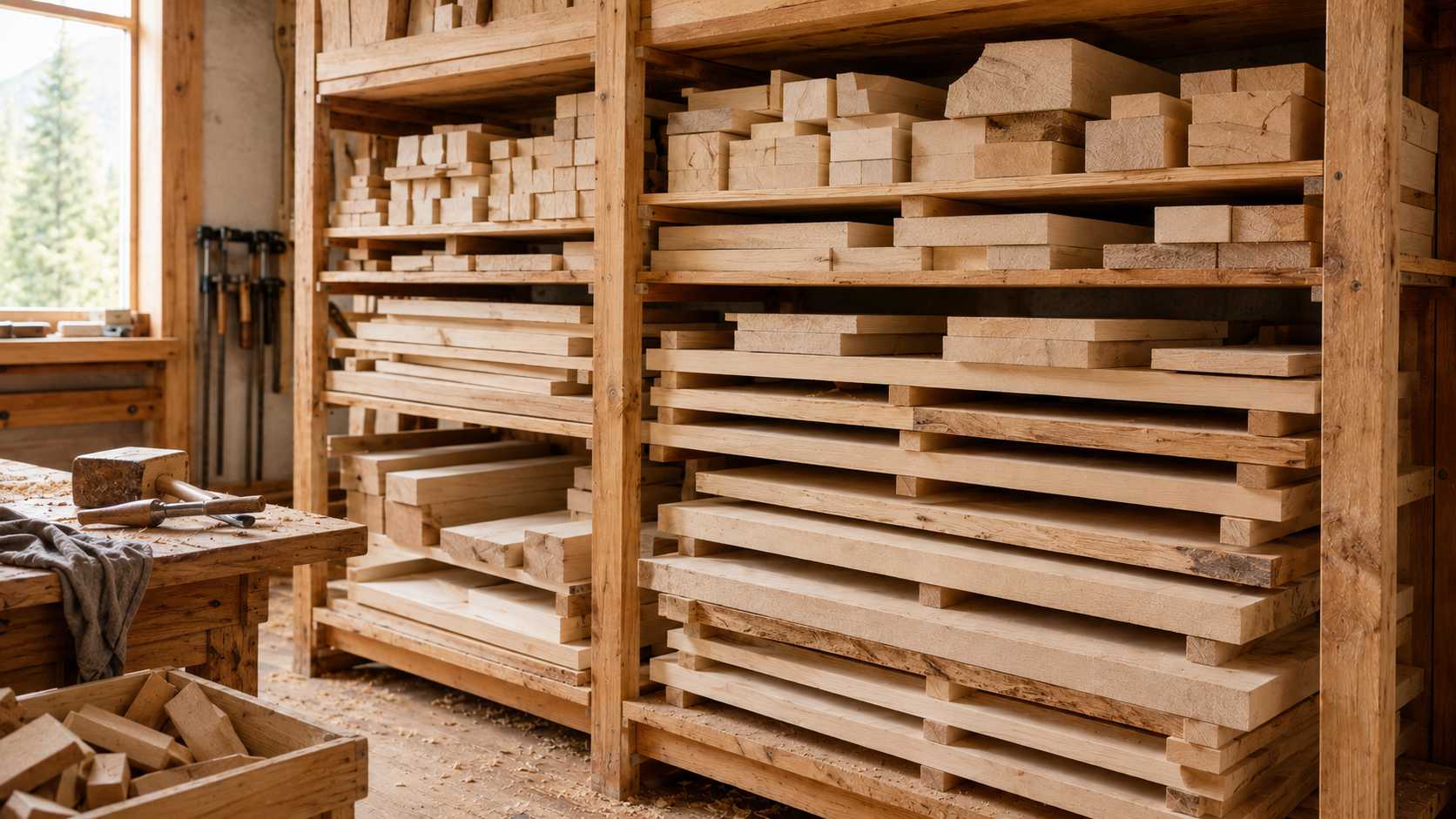
Boards are best stored horizontally on a flat surface. Place dry battens of equal thickness between the individual boards. These battens should be aligned vertically one above the other so that the weight is distributed evenly.
Large wood blocks should not stand directly on concrete or a damp floor. A dry base and air circulation on multiple sides reduce the risk of uneven moisture.
Can carving wood be stored in plastic?
Dry carving wood should generally not be permanently sealed in plastic. If there is residual moisture in the wood or condensation gets into the bag, the moisture cannot escape. This increases the risk of mold and discoloration.
Plastic packaging can be useful for short transport or for green wood that is intentionally kept moist. However, the wood must then be checked regularly. For long-term storage of dry carving wood, an open cardboard box, a shelf, or a breathable cover are usually more suitable.
Important: If water droplets form on the inside of a bag, you should immediately remove the wood and allow it to air out in a dry, well-ventilated place.
Carving dry or fresh wood?
Both options are possible, but they are suitable for different projects.
Dry carving wood
Dry wood is more dimensionally stable and is particularly suitable for figures, reliefs, gifts, and workpieces that should change as little as possible later on. It requires a sharp tool, but provides a good basis for fine details.
Advantages of dry carving wood:
-
lower risk of later shape changes
-
good for detailed figures and relief work
-
surfaces can be finely finished directly
-
finished workpieces are more predictable
Fresh or green wood
Freshly cut wood contains significantly more moisture and is often easier to work with. It is suitable, for example, for spoons, bowls, and traditional greenwood projects. However, during subsequent drying, it can shrink, warp, or crack.
For greenwood, proper drying is a separate issue. The workpiece should dry slowly and evenly. Direct sunlight, heating, or a hot room increase the risk of cracking.
For beginners who want a durable and predictable result, dry, evenly grown carving wood made of basswood, Swiss pine, or maple is often the easier choice.
If you are still considering different types of wood, our guide Which carving wood is suitable for beginners? will help you. For clean cuts, you should also be able to recognize the grain direction when carving.
What wood moisture is suitable for carving?
There is no single value that is perfect for every type of wood, every project, and every storage room. For dry wood indoors, it is crucial that the wood has adapted to its future environment and its moisture content no longer changes significantly.

Many technically dried carving woods fall roughly within the range of typical indoor wood moisture levels. At EdpaS, for example, a large part of the basswood offered is technically dried and often has a wood moisture content of about 10 to 12 percent, depending on the product. Always refer to the product information for details.
For more precise control, you can use a wood moisture meter. Keep the following in mind:
-
Measure at as many points as possible.
-
With thick blocks, the surface can be drier than the interior.
-
Observe the operating instructions and the selected wood type.
-
Individual measurements are less informative than several comparable measurements.
It's not just the measured value that counts: smell, surface, weight, and changes over several days provide additional clues.
Avoiding cracks in carving wood
Cracks often occur when the outer areas dry faster than the interior. The end grain, in particular, releases moisture quickly.
These measures help:
-
Do not dry wood next to radiators.
-
Avoid direct sunlight.
-
Reduce large temperature fluctuations.
-
Support boards and turning blanks evenly.
-
Allow large pieces to slowly acclimatize to the working environment.
-
Do not treat fresh wood like already dried wood.
Small natural changes cannot be completely ruled out with solid wood. However, significantly increasing cracks are a sign that you should check the storage location, temperature, and humidity.
Avoiding mold on carving wood
Mold requires moisture and grows particularly well with poor air circulation. Regularly inspect stored wood, especially in basements, garages, and closed containers.
Look out for:
-
musty or unusual smell
-
furry or speckled coatings
-
damp spots on wood or packaging
-
condensation in plastic containers
-
dark discolorations that change or spread
If visible mold is present, you should separate the affected wood from other pieces. Do not simply work over it, and avoid spreading spores into the air by dry brushing or sanding. In the case of widespread or deep infestation, safe disposal is often the most sensible solution.
Natural color differences, mineral streaks, or typical grain are not automatically mold. If in doubt, smell, surface texture, and observing whether the spot changes can help.
Preventing warping in boards and turning blanks
Warping occurs when a piece of wood changes unevenly or is supported incorrectly. Thin boards and long turning blanks are particularly sensitive.
Here's how to reduce the risk:
-
Store boards flat, not leaning against a wall at an angle.
-
Use a straight, dry base.
-
Use battens at regular intervals.
-
Align all battens exactly one above the other.
-
Do not place heavy objects at single points.
-
Allow air to reach as many sides of the wood as possible.
If boards are stored vertically, they must be fully and straightly supported. For longer storage, a neat horizontal stack is often safer.
Common mistakes in storing carving wood
Mistake 1: Storage directly next to the heating system
The surface dries too quickly, while the interior may still be damper. This creates tension and potentially cracks.
Mistake 2: Permanently closed plastic packaging
Moisture cannot escape. This promotes condensation and mold.
Mistake 3: Leaning boards against the wall at an angle
Without full support, long or thin boards can warp.
Mistake 4: Storing wood directly on concrete
Concrete can be cool and damp. Use a dry base and keep it off the floor.
Mistake 5: Drying fresh wood too quickly
Sun, radiators, or a very warm room only accelerate external drying. This increases the risk of cracks.
Mistake 6: Infrequent checking
Anyone storing their wood for several months should regularly check for moisture, deformations, pests, and unusual smells.
Properly storing carving wood: the short checklist
-
Store dry and well-ventilated.
-
Avoid direct sun and radiator heat.
-
Do not permanently seal in airtight packaging.
-
Keep distance from the floor and damp walls.
-
Store boards flat and evenly supported.
-
Acclimatize wood to the workspace before carving.
-
Regularly check stock for moisture and mold.
-
For large or valuable pieces, conduct multiple moisture measurements.
Conclusion: Consistent conditions protect your carving wood
Carving wood does not require a particularly warm storage place. Crucial factors are a dry environment, air circulation, and minimal fluctuations. Store small blocks loosely in an open box or on a shelf, and store boards and long timber flat and evenly supported.
Avoid direct sunlight, radiators, damp floors, and permanently sealed plastic bags. This will keep your wood dimensionally stable and easy to work with until you start your next carving project.
Looking for suitable material? At EdpaS, you'll find basswood for carving, other carving woods, and pre-prepared carving blanks for beginners and experienced carvers.
FAQ: Frequently Asked Questions about Storing Carving Wood
What is the best way to store carving wood?
Store carving wood in a dry, well-ventilated place, away from direct sunlight or radiator heat. Small blocks can be kept in an open box or on a shelf. Boards should be stacked flat, level, and with evenly spaced stickers.
Can I store basswood in the basement?
Only if the basement is dry and well-ventilated. In damp basements, the risk of mold, mildew, and warping increases. Never store wood directly on the basement floor or immediately against a damp exterior wall.
Should carving wood be left in a plastic bag?
Dry carving wood should not be kept airtight in a plastic bag permanently. Trapped moisture can lead to condensation and mold. For long-term storage, airy storage is usually better.
Why does my carving wood crack?
Cracks often occur due to too rapid or uneven drying. Direct sunlight, radiators, large temperature changes, and particularly fast-drying end grains can cause stress in the wood.
Should carving wood be stored standing or lying down?
For longer storage, boards and long timber should preferably be stored flat and fully supported. Small carving blocks can be stored lying down or standing up, as long as they are kept dry and receive adequate air circulation.
How long should wood rest after delivery?
For demanding projects, it is advisable to let the wood rest for a few days in the environment where it will be worked. Large blocks require longer to fully acclimatize than small carving pieces.
Is dry or fresh wood better for carving?
Dry wood is more dimensionally stable and well-suited for detailed figures, reliefs, and gifts. Fresh wood is often easier to cut, but it can warp or crack during subsequent drying.
What is the correct wood moisture content for carving wood?
This depends on the wood type, project, and environment. For dry indoor projects, the wood should be adapted to the subsequent room climate. Many technically dried carving woods fall roughly within the range of typical indoor wood moisture levels. Always observe the product information.
What should I do if there is mold on carving wood?
Immediately separate the affected wood from the other pieces. Avoid dry brushing or sanding indoors, as this can spread spores. For widespread or deep infestations, safe disposal is often the best solution.