
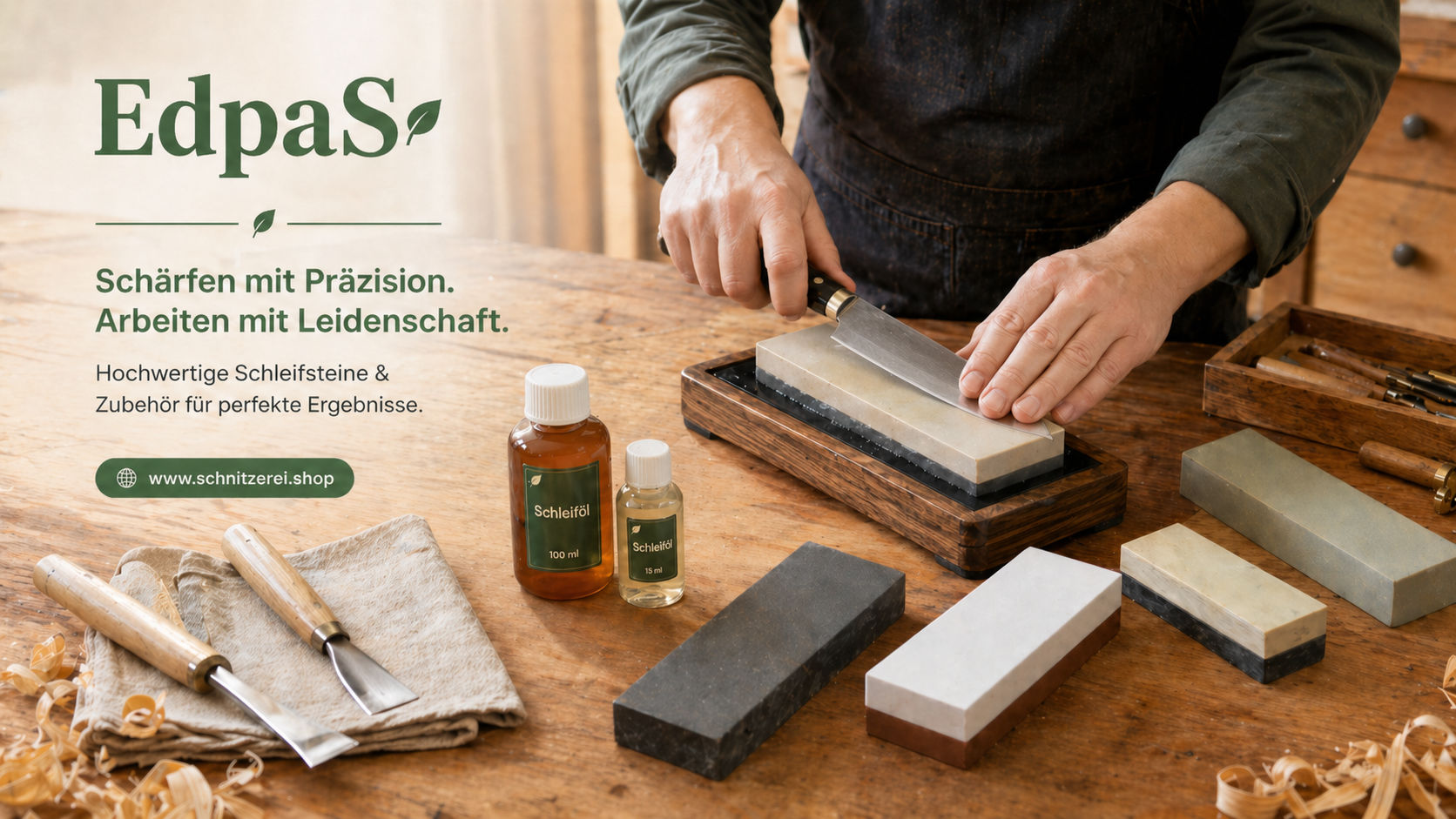
Oilstone or Whetstone? The Ultimate Comparison for Sharp Carving Knives, Chisels and Tools
Anyone who wants to properly sharpen carving knives, chisels, plane irons or other cutting tools quickly faces an important question: should I use an oilstone or a whetstone? Both sharpening systems have clear advantages, but also differences in application, maintenance, sharpening feel, and speed.
In this guide, we will explain in a simple and practical way the differences between oilstones and whetstones, which sharpening stone is suitable for which tools, and what you should consider when sharpening your carving tools.
Briefly explained: Whetstones usually work quickly and aggressively in material removal but need to be flattened more often. Oilstones are often harder, more dimensionally stable, and particularly interesting for fine edges, shaped stones, and tools with small contact surfaces.
Table of Contents
- What is a Sharpening Stone?
- Why are Sharpening Stones Used with Liquid?
- Oilstone vs. Whetstone – The Most Important Difference
- What is a Whetstone?
- What is an Oilstone?
- Advantages of Whetstones
- Disadvantages of Whetstones
- Advantages of Oilstones
- Disadvantages of Oilstones
- Oilstone or Whetstone? Comparison in a Table
- Which Stone is Suitable for Carving Knives?
- Which Stone is Suitable for Chisels and Plane Irons?
- Shaped Stones for Carving Tools
- Corrosion, Cleaning and Maintenance
- Which Grit is Useful?
- Common Sharpening Mistakes
- Decision Aid: Which Sharpening Stone Suits You?
- Frequently Asked Questions about Oilstones and Whetstones
- EdpaS Recommendation
- Conclusion: Oilstone or Whetstone?
What is a Sharpening Stone?
A sharpening stone is an abrasive tool used to restore the edge of a tool. When sharpening, very little material is removed from the edge. This creates a clean, fine, and sharp cutting edge again.
Sharpening stones are used for many tools:
- ✔ Carving knives
- ✔ Chip carving knives
- ✔ Chisels
- ✔ Gouges
- ✔ Plane irons
- ✔ Kitchen knives
- ✔ Turning tools
- ✔ Outdoor and workshop knives
Depending on the material, bond, and grit, a sharpening stone works faster, finer, harder, or softer. This is precisely where oilstones and whetstones differ particularly significantly.
Why are Sharpening Stones Used with Liquid?
Many people think that water or oil only serves as a lubricant during sharpening. This is partially true, but it is not the most important point. The liquid primarily ensures that abrasive particles do not get stuck in the stone's surface.
During sharpening, fine particles of steel and stone are generated. Without water or oil, these particles can clog the pores of the stone. The stone then loses its abrasive performance and feels dull or smooth when used.
The liquid therefore helps to:
- ✔ release abrasive particles from the surface
- ✔ keep the abrasive particles free
- ✔ make the friction more even
- ✔ create a controlled sharpening feel
- ✔ process the cutting edge more cleanly
Therefore, sharpening stones should always be used as recommended by the manufacturer: either with water, with oil, or, for special stones, dry or with optional liquid.
Oilstone vs. Whetstone – The Most Important Difference
The biggest difference is not only in the liquid used. The decisive factors are primarily hardness, bond, abrasion, and maintenance effort.
Whetstones are often softer bonded. This means that spent abrasive particles are released more quickly from the surface. New, sharp abrasive grains are exposed. This makes many whetstones very fast and efficient.
Oilstones, on the other hand, are often harder and more dimensionally stable. They wear down more slowly and stay flat longer. However, they usually work somewhat slower than many whetstones.
- ✔ Whetstone: fast removal, softer, more frequent flattening
- ✔ Oilstone: harder, more dimensionally stable, slower removal
- ✔ Water: easily available, cleaner to handle
- ✔ Oil: protects better against rust, but can leave more residue
What is a Whetstone?
A whetstone is a sharpening stone that is used with water. Before sharpening, the stone is either briefly moistened or soaked for a few minutes, depending on the design. Some modern whetstones are so-called splash-and-go stones. These do not need to be soaked for a long time but can be used directly with water on the surface.
Whetstones are particularly popular because they are pleasant to work with and often remove material very quickly. They are widely used, especially for knives, chisels, and plane irons.
Typical characteristics of whetstones:
- ✔ used with water
- ✔ usually fast material removal
- ✔ good sharpening feel
- ✔ many grits available
- ✔ ideal for fine edges
- ✔ need to be regularly flattened depending on hardness
For beginners, whetstones are often a good starting point because water is readily available and the application remains clean and understandable.
What is an Oilstone?
An oilstone is a sharpening stone used with thin honing oil. Oil prevents metal abrasion from penetrating deeply into the stone's surface. At the same time, it better protects rusting steels from moisture.
Oilstones are often harder than many whetstones. This means they remain flat longer and are particularly suitable for tools with small contact surfaces or for shaped stones that should retain their contour for as long as possible.
Typical characteristics of oilstones:
- ✔ used with honing oil
- ✔ usually hard and dimensionally stable
- ✔ wear down slowly
- ✔ remain flat longer
- ✔ good for precise edges and shaped stones
- ✔ cleaning is somewhat more elaborate than with whetstones
Oilstones are often valued by users who want to sharpen in a very controlled and calm manner.
Advantages of Whetstones
Whetstones are popular in many workshops because they work quickly and are easy to handle. Especially for regular sharpening of knives, chisels, and plane irons, they offer many advantages.
- ✔ fast material removal
- ✔ water is inexpensive and available almost everywhere
- ✔ no oil film on tools or work surface
- ✔ pleasant sharpening feel
- ✔ wide selection of grits
- ✔ very well suited for fine edges
- ✔ ideal for workshop, kitchen, and hobby use
Another advantage is easy cleaning. After sharpening, many whetstones can simply be rinsed with water. The tools can also be cleaned and dried quickly.
Disadvantages of Whetstones
Whetstones also have disadvantages. Because many whetstones are softer bonded, they wear down more quickly. Especially with narrow tools or localized pressure, grooves or unevenness can occur.
- ✔ wear down faster than many oilstones
- ✔ need to be flattened regularly
- ✔ water can cause rust on carbon steel
- ✔ some stones need to be soaked before use
- ✔ sensitive stones can be damaged by improper storage
Important: After sharpening with water, rusting tools should always be thoroughly dried. For carbon steel carving knives and chisels, it is advisable to lightly oil the blade afterwards.
Advantages of Oilstones
Oilstones particularly excel due to their hardness and dimensional stability. They remain flat longer and are especially interesting when precise tools need to be sharpened.
- ✔ very dimensionally stable
- ✔ stay flat longer
- ✔ ideal for small contact surfaces
- ✔ good for shaped stones and curved edges
- ✔ oil protects rusting steels better against corrosion
- ✔ durable with proper care
- ✔ smooth, controlled sharpening feel
Especially for carving tools with curves, gouges, or special profile shapes, oilstones and suitable shaped stones can be very useful.
Disadvantages of Oilstones
Oilstones are not the most convenient solution for every user. Working with oil is a bit more involved, and cleaning requires more attention.
- ✔ usually slower material removal than with many whetstones
- ✔ honing oil must be available
- ✔ oil can leave stains on wood, fabric, or work surfaces
- ✔ cleaning is more complex
- ✔ less practical for on-the-go
- ✔ stones once used with oil should generally not be switched back to water
Especially in a clean woodworking shop, care should be taken to ensure that oil does not get onto untreated wooden surfaces, workpieces, or packaging material.
Oilstone or Whetstone? Comparison in a Table
The following table will help you quickly understand the differences.
| Feature | Whetstone | Oilstone |
|---|---|---|
| Liquid | Water | Honing oil |
| Material removal | usually fast | usually slower and more controlled |
| Hardness | often softer | often harder |
| Dimensional stability | needs to be flattened more often | stays flat longer |
| Maintenance | easy to clean with water | cleaning with oil/solvent more complex |
| Rust protection | tool must be dried thoroughly | oil protects better against rust |
| For beginners | very well suited | good, but a bit more maintenance-intensive |
| For carving tools | good for straight edges and knives | very good for shaped stones and curves |
| For on the go | more practical | less practical |
Which Stone is Suitable for Carving Knives?
Both systems are fundamentally suitable for carving knives. The better choice depends on how you work and which tools you want to sharpen.
For classic carving knives with a straight or slightly curved edge, whetstones are very popular. They remove material quickly, are easy to control, and produce a very sharp edge with the right technique.
Oilstones are interesting if you want to work particularly precisely or are looking for a stone that retains its shape for a long time. For fine honing work, high-quality oilstones can deliver very good results.
For carving beginners, the following are often recommended:
- ✔ a medium sharpening stone for resharpening
- ✔ a fine stone or honing compound for edge maintenance
- ✔ a leather stropping belt with polishing paste
- ✔ regular stropping instead of waiting too long to resharpen
When carving, a sharp blade is particularly important. A dull blade requires more pressure, is harder to control, and can therefore become more unsafe.
Which Stone is Suitable for Chisels and Plane Irons?
For chisels and plane irons, a flat, straight cutting edge is crucial. Therefore, a flat sharpening stone is particularly important. Whetstones are very suitable if they are regularly flattened.
Oilstones have the advantage here that they stay flat longer. Those who work very precisely and want to flatten less frequently can achieve very good results with a harder oilstone.
For chisels and plane irons, the following applies:
- ✔ the stone must be flat
- ✔ the angle should be maintained consistently
- ✔ the back side should be cleanly worked
- ✔ the burr should be removed after sharpening
- ✔ fine honing significantly improves cutting performance
Anyone who works regularly with wood should not check the condition of their chisels only when they are completely dull. Brief resharpening saves time and provides cleaner wood surfaces.
Shaped Stones for Carving Tools
Carving tools often have special shapes. Gouges, V-tools, or curved edges cannot always be sharpened optimally on a flat bench stone. For this, there are shaped stones, profile stones, or small honing stones.
Shaped stones are particularly helpful for:
- ✔ Gouges
- ✔ V-tools
- ✔ heavily rounded edges
- ✔ internal bevels
- ✔ small carving profiles
- ✔ sculpting tools
Here, hard stones have advantages because they retain their shape longer. If a shaped stone wears too quickly, its profile changes. Then it no longer cleanly matches the tool's shape.
For carving tools, not only the grit is important, but also the shape of the sharpening medium. A good sharpening system for carvers often consists of several components: bench stone, shaped stone, leather, and polishing paste.
Corrosion, Cleaning and Maintenance
With whetstones, particular attention should be paid to rust protection after sharpening. Many carving knives, chisels, and classic tools are made of carbon steel or stainless, but not completely rust-free, steel.
After sharpening with water, you should:
- ✔ thoroughly dry the blade
- ✔ remove water residue near the handle
- ✔ clean the stone
- ✔ let the stone dry properly
- ✔ lightly oil sensitive blades if necessary
With oilstones, rust is less of a problem, but the stone must be kept clean. Metal abrasion and oil residues can contaminate the surface over time. Then the stone loses performance.
With oilstones, you should:
- ✔ use only suitable honing oil
- ✔ wipe off excess oil
- ✔ protect the stone from dust
- ✔ clean contaminated surfaces
- ✔ do not get oil on untreated wooden workpieces
Important: Use a sharpening stone with the same medium as consistently as possible. A stone that has been used with oil for a long time can usually only be effectively used with water again with difficulty.
Which Grit is Useful?
The grit determines how coarse or fine a sharpening stone works. Coarse grits remove more material, fine grits refine the edge.
For many woodworking tools, a combination of medium and fine grit is useful.
- ✔ coarse grit: for damaged or very dull edges
- ✔ medium grit: for regular resharpening
- ✔ fine grit: for fine edges and stropping
- ✔ leather with polishing paste: for the final touch
For carving knives, it's often not about significant material removal, but rather regular edge maintenance. If you frequently strop your knife briefly, you'll need to resharpen it less intensely.
A simple basic kit might look like this:
- ✔ a sharpening stone in the medium range
- ✔ a fine stone or stropping stone
- ✔ a leather strop
- ✔ suitable polishing paste
Common sharpening mistakes
Many problems during sharpening don't come from the stone, but from incorrect application. A good sharpening stone can only work cleanly if the angle, pressure, and maintenance are right.
Typical mistakes include:
- ✔ too much pressure when sharpening
- ✔ inconsistent sharpening angle
- ✔ truing waterstones too infrequently
- ✔ using the wrong liquid with the sharpening stone
- ✔ trying to use an oilstone with water after using oil
- ✔ not drying tools after water contact
- ✔ waiting too long until the blade is completely dull
- ✔ not cleanly removing the burr
Especially when carving, it's better to resharpen or strop briefly and regularly, rather than waiting until the blade barely cuts anymore.
Decision aid: Which sharpening stone is right for you?
The choice between an oilstone and a waterstone depends on which tools you want to sharpen and how you work.
A waterstone is useful if:
- ✔ you want to sharpen quickly and efficiently
- ✔ you primarily sharpen knives, chisels, or plane irons
- ✔ you prefer easy cleaning
- ✔ you don't want to use oil in the workshop
- ✔ you want to work with water as a medium
An oilstone is useful if:
- ✔ you are looking for a very dimensionally stable stone
- ✔ you sharpen carving tools with small contact surfaces
- ✔ you use shaped stones for gouges or profiles
- ✔ you prefer controlled, smooth material removal
- ✔ rust protection during sharpening is important
For many users, "either or" is not the best solution. In practice, a combination can be useful: a waterstone for quick material removal, a fine stone or leather for stropping, and special shaped stones for carving tools.
Frequently asked questions about oilstones and waterstones
What is better: oilstone or waterstone?
That depends on the application. Waterstones are usually faster and easier to clean. Oilstones are often more dimensionally stable and stay flat longer. Both are suitable for carving knives and chisels if used correctly.
What is the advantage of a waterstone?
A waterstone usually works quickly, only requires water, and provides a pleasant sharpening feel. It is particularly practical for knives, chisels, and plane irons.
What is the advantage of an oilstone?
An oilstone is often harder and more dimensionally stable. It stays flat longer and is well suited for tools with small contact surfaces or for shaped stones for carving tools.
Can an oilstone be used with water?
Normally, you shouldn't. A stone intended for oil or already used with oil should continue to be used with oil. Switching back to water is often difficult.
Can a waterstone be used with oil?
Generally no. Waterstones are designed for water. Oil can clog the pores and reduce sharpening performance. Always follow the manufacturer's instructions.
Why do waterstones need to be trued?
Many waterstones wear down during sharpening. This can create hollows. An uneven stone makes precise sharpening difficult. Truing makes the surface flat again.
Which sharpening stone is good for carving knives?
For carving knives, a fine to medium sharpening stone in combination with a leather strop is suitable. For gouges and curved tools, shaped stones are also useful.
Why can water cause rust when sharpening?
Many tools are made of rusting carbon steel. If water remains on the blade after sharpening, rust can form. Therefore, blades should always be thoroughly dried.
What is easier for beginners?
For many beginners, a waterstone is easier because water is readily available and cleaning remains straightforward. However, it is important to keep the stone flat regularly and to dry the blade after sharpening.
EdpaS Recommendation
Sharp tools are crucial for clean carving. Beginners, in particular, often underestimate how much sharpness influences the carving result. A sharp knife cuts more controllably, requires less force, and allows for finer details in the wood.
At EdpaS, you'll find products for getting started and for the regular care of your carving tools:
- ✔ Carving knife sets for beginners and advanced users
- ✔ Sharpening stones and accessories for resharpening
- ✔ Basswood blanks for first carving projects
- ✔ Carving gloves for more protection and grip
- ✔ Carving templates and learning videos to follow along
Especially for beginners, it makes sense not only to pay attention to the tool itself, but also to the appropriate sharpening accessories. Because only a regularly maintained carving knife remains pleasant and safe to use in the long term.
To the EdpaS Carving Knife Set
Conclusion: Oilstone or Waterstone?
Both oilstones and waterstones have their place. Waterstones are fast, practical, and very well suited for many tools. Oilstones are dimensionally stable, durable, and particularly interesting for precise work, shaped stones, and tools with small contact surfaces.
For carving knives, chisels, and woodworking tools, the best sharpening stone is the one you use regularly and correctly. A well-maintained edge makes working with wood easier, cleaner, and safer.
Key takeaway: Waterstones are fast and straightforward. Oilstones are dimensionally stable and controlled. For carving tools, a combination of a sharpening stone, a shaped stone, and a leather strop can be particularly useful.