
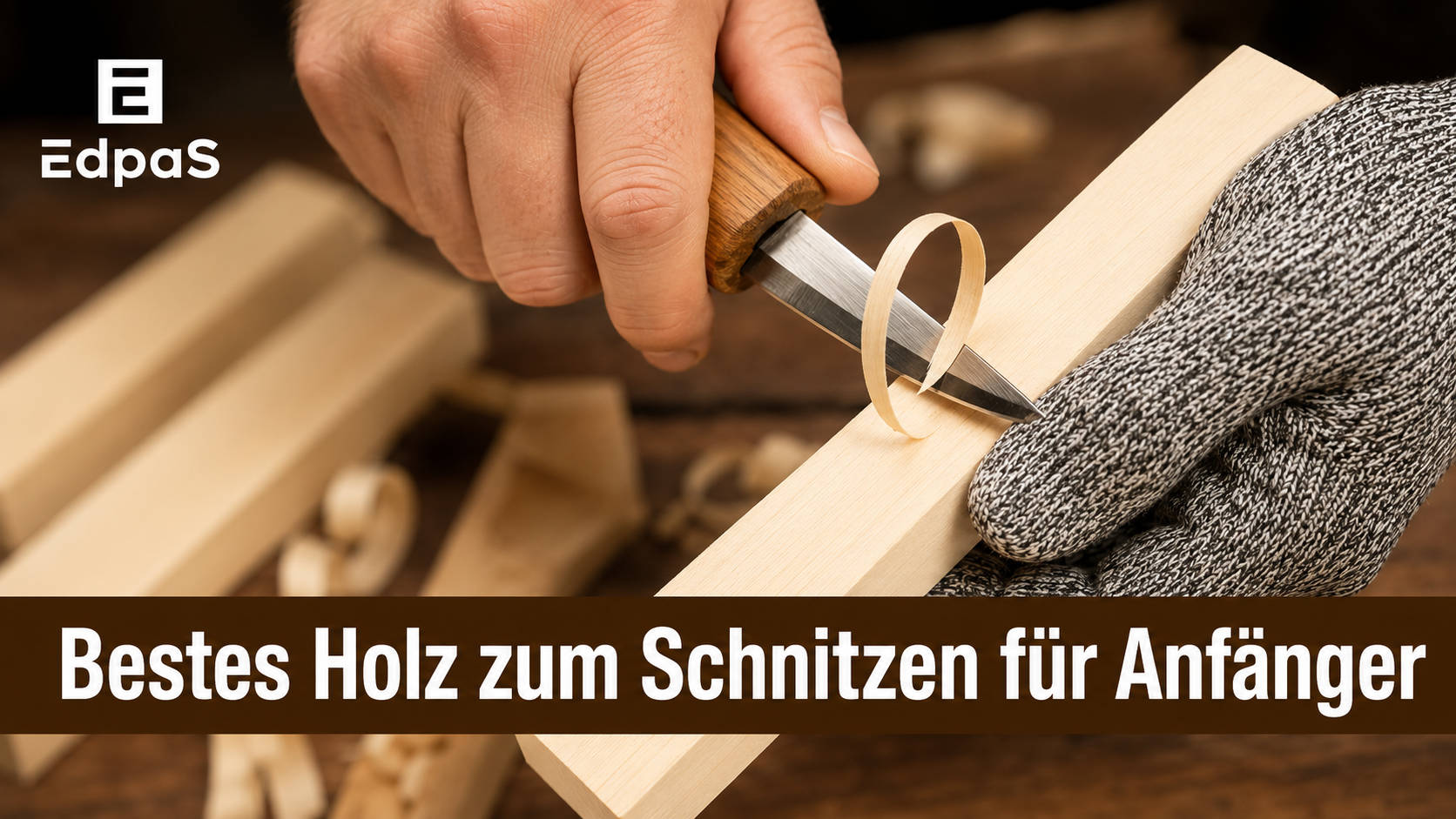
Best Wood for Beginner Carving: A Comparison of Basswood, Swiss Pine, & Alder
Table of Contents
What is the best wood for carving?
Basswood: The best choice for beginners
Swiss Pine: Fragrant wood for creative carvings
Alder: Versatile wood for simple carving projects
Maple: Hardwood for advanced carvers
Basswood, Swiss Pine, or Alder – which wood is right for you?
What to look for when buying carving wood
The right tools for carving
Safety while carving
EdpaS product recommendations
Additional note on wood
Conclusion: Which wood is ideal for carving?
What is the best wood for carving?
Anyone starting out with carving quickly asks: What is the best wood for carving? The answer depends heavily on whether you are a beginner, want to carve your first figures, or already have experience with harder woods.
For beginners, soft, evenly grown woods are ideal. They are easier to cut, require less force, and allow for clean cuts with a carving knife. Basswood, Swiss Pine, and Alder have proven particularly effective.
Basswood is the most popular choice for beginners. Swiss Pine is particularly well suited for fragrant decorative pieces and unique natural items. Alder is versatile and offers a nice alternative for simple carving projects. Maple, on the other hand, is significantly harder and more suitable for advanced carvers.
Basswood: The best choice for beginners
Basswood is one of the most popular woods for carving. It is soft, fine-grained, and has a very uniform structure. This makes it particularly pleasant to work with and ideal for beginners, children under supervision, hobby carvers, and creative family projects.
When carving with basswood, the knife glides controllably through the material. The wood splinters very little, is easy to shape, and is suitable for both simple exercises and more detailed work. Basswood is an excellent choice for figures, animals, gnomes, chip carvings, or small decorations.
Another advantage: Basswood tolerates small mistakes better than many harder woods. If a cut isn't quite perfect, the shape can often still be reworked well. This makes basswood particularly beginner-friendly.
Advantages of basswood for carving
✔ very suitable for beginners
✔ soft and pleasant to cut
✔ uniform structure for clean cuts
✔ ideal for figures, animals, gnomes, and practice pieces
✔ well suited for chip carving and detailed work
✔ can be sanded, painted, oiled, or waxed after carving
✔ ideal for first carving projects with children under supervision
At EdpaS, you'll find various basswood blanks for different projects. Basswood sets with multiple blanks in various sizes are particularly practical for getting started. This allows you to try out different shapes and implement your first carving ideas.
Typical applications for basswood
✔ first carving exercises
✔ small figures and animals
✔ simple wooden figures
✔ chip carving
✔ pendants and small decorative objects
✔ practice pieces for stop-cut, V-cut, and push-cut
Swiss Pine: Fragrant wood for creative carvings

Swiss pine is a special carving wood that impresses primarily with its pleasant natural scent and warm appearance. It has a more vibrant grain than basswood and may contain small knots, inclusions, or color variations. These natural characteristics are precisely what give Swiss pine its particularly distinctive character.
Compared to basswood, Swiss pine often appears more rustic and expressive. It is very well suited for decorative carvings, small figures, pendants, gift ideas, decorative objects, and unique creative pieces. If you want to carve a natural-looking workpiece with special charisma, Swiss pine is a good choice.
For absolute beginners, basswood is usually a little easier to work with because it is calmer and more uniform. However, Swiss pine is also easy to carve and particularly interesting if you are specifically looking for a wood with natural grain, scent, and lively character.
Advantages of Swiss pine for carving
✔ pleasant natural Swiss pine scent
✔ warm, vibrant wood appearance
✔ ideal for decorations, figures, and gift ideas
✔ each piece is unique
✔ beautiful grain for natural carvings
✔ particularly popular for decorative wood projects
Typical applications for Swiss pine
✔ decorative figures
✔ small pendants
✔ natural gift ideas
✔ rustic wooden objects
✔ creative unique pieces
✔ fragrant wood decorations
Important to know: Swiss pine can look different depending on the piece. Small knots, inclusions, color differences, or vibrant grains are typical for Swiss pine and make up the natural character of the wood.
Alder: Versatile wood for simple carving projects

Alder is an interesting alternative to basswood and Swiss pine. It has a relatively uniform structure, is easy to work with, and has a beautiful warm, slightly reddish color. As a result, finished carvings made of alder often appear particularly natural and friendly.
Alder is slightly firmer than very soft basswood but remains pleasantly usable for many carving projects. This makes alder well suited for beginners with some experience, hobby carvers, and creative projects where a slightly different wood appearance is desired.
Alder is particularly beautiful for simple figures, crafts, small decorative objects, and natural woodcrafts. Its uniform structure allows for controlled processing, while visually it brings more warmth and color than very light basswood.
Advantages of alder for carving
✔ easy to work with
✔ uniform structure
✔ beautiful warm wood color
✔ versatile
✔ suitable for simple figures and crafts
✔ good alternative to basswood
✔ ideal for trying out different types of wood
Typical applications for alder
✔ simple figures
✔ crafts
✔ decorative objects
✔ small wooden shapes
✔ creative projects for hobby carvers
✔ carvings with a warm wood appearance
If you have already gained some experience with basswood and want to try a slightly different wood, alder is a good choice. It is not too hard, but offers a different look and a slightly different carving feel.
Maple: Hardwood for advanced carvers
Maple is a light, firm, and high-quality looking wood. It has a fine structure and can produce very beautiful results. When carving, however, maple is significantly harder than basswood, Swiss pine, or alder.
For beginners, maple is therefore usually not the best choice. The wood requires more force, a clean cutting technique, and very sharp tools. Those with little experience can slip more easily or create unclean cuts with maple because the material offers more resistance.
For advanced carvers, however, maple can be very interesting. Especially smaller, precise works, decorative details, or firm workpieces can be made from it if the tools and technique are a good match.
Advantages of maple
✔ light, elegant appearance
✔ firm and fine structure
✔ well suited for experienced carvers
✔ beautiful surface after sanding
✔ ideal for smaller, precise work with sharp tools
We do not recommend maple for starting out with carving. Those who first practice with basswood and gain more confidence in handling the knife can later switch to harder woods like maple.
Basswood, Swiss Pine, or Alder – which wood is right for you?
Each type of wood has its own advantages. Which wood is best depends on what you want to carve and how much experience you already have.
Basswood is right for you if:
✔ you are a beginner
✔ you are looking for a soft and easy-to-carve wood
✔ you want to carve figures, animals, or practice pieces
✔ you prefer clean cuts and a calm structure
✔ you want to carve with children under supervision
Swiss Pine is right for you if:
✔ you want to carve natural decorative objects
✔ you like the pleasant Swiss pine scent
✔ you find vibrant grain and knots beautiful
✔ you want to create a characteristic unique piece
✔ you prefer a rustic and natural wood look
Alder is right for you if:
✔ you want to try an alternative to basswood
✔ you prefer a warm wood color
✔ you want to carve simple figures or crafts
✔ you have already gained some carving experience
✔ you are looking for a versatile wood for creative projects
What to look for when buying carving wood
When buying carving wood, it's not just about the type of wood. Quality, storage, cut, and natural properties also play an important role.
Uniform structure
For beginners, a uniform wood structure is particularly important. The calmer the wood has grown, the easier it is to cut controllably.
✔ clean cutting
✔ less tearing
✔ better control when carving
✔ especially important for figures and details
Appropriate size
Small and medium blanks are particularly good for beginners. They are easier to hold, turn, and work with. Larger blocks or billets are ideal if you already have more experience or want to carve larger figures.
✔ small blanks for first exercises
✔ medium pieces for figures and animals
✔ larger billets for more extensive projects
✔ various sizes for more creative possibilities
Dry wood
Carving wood should be well stored and sufficiently dry. Wood that is too moist can warp or crack when drying. Wood that is too dry or improperly stored can become brittle.
Small cracks can occur in wood and are not automatically a quality defect. Wood continues to work depending on the environment, temperature, and humidity.
Knots, color, and grain
Wood is a natural product. Color, grain, small knots, and slight discolorations can vary from piece to piece. Especially with Swiss pine, knots and inclusions are often typical and characterize the natural essence of the wood.
The right tools for carving

In addition to the right wood, good tools are crucial. A sharp carving knife is important so you can work cleanly and controllably. A dull knife is often more dangerous when carving because more force is required and the blade can slip more easily.
For beginners, a carving knife set with various knives, accessories, and practice material is particularly suitable. This allows you to try out different cuts and get started directly with suitable wood blanks.
Useful carving accessories
✔ carving knife for rough shapes
✔ detail knife for fine work
✔ chip carving knife for lines and patterns
✔ sandpaper for smoothing
✔ sharpening stone or leather strop for resharpening
✔ cut-resistant gloves for added safety
✔ basswood blanks for first projects
Safety while carving
Carving is a creative hobby, but it should always be carried out consciously and controllably. Children, in particular, should only carve under supervision. Adults should also ensure a safe working method.
Important safety tips
✔ always carve away from your body
✔ work with calm movements
✔ do not cut with too much force
✔ use sharp knives controllably
✔ wear cut-resistant gloves
✔ work on a stable surface
✔ hold the wood piece securely
✔ store knives safely after use
Especially at the beginning, it is better to carve slowly and cleanly, rather than trying to remove as much material as possible at once. With the right technique, better results are achieved and carving becomes safer.
EdpaS product recommendations
If you are still unsure which wood or tool is best, you can start particularly easily with soft basswood and a complete carving knife set. For fragrant decorative pieces, Swiss pine is suitable, while alder is a nice alternative for simple creative projects.
✔ EdpaS Starter Set Basswood – 10 Carving Blanks in 3 Sizes
✔ Kirschen Carving Knife Set 3-piece
✔ EdpaS Carving Knife Set for Beginners 17-piece
✔ Basswood for Carving & Turning
✔ Carving Wood for Beginners, Hobbies & Creative Wood Projects
✔ Carving Knives & Carving Tools
✔ Swiss Pine for Carvings, Decorations & Creative Projects
✔ Cut-Resistant Gloves for Safe Carving
Additional note on wood
Note: It is important to note that wood is a natural product, which means the delivered wood piece may differ slightly in color and grain from the illustration. The wood may have slight discolorations and smaller knots. Small differences are not a defect, but rather make each workpiece a unique item. Small cracks can occur and are not automatically a quality defect, but a natural property of wood.
Conclusion: Which wood is ideal for carving?
For starting out with carving, basswood is the best choice. It is soft, uniform, easy to control, and ideal for first figures, animals, gnomes, chip carvings, and practice pieces.
Swiss pine is particularly well suited for natural decorative pieces, fragrant wooden objects, and characteristic unique items. Alder is a versatile alternative with warm color and good workability.
Maple, on the other hand, is significantly harder and more suitable for advanced carvers. Those just starting out with carving should first start with basswood and later try harder woods.
With the right wood, a sharp carving knife, and a little patience, the first carving projects will be much easier.