
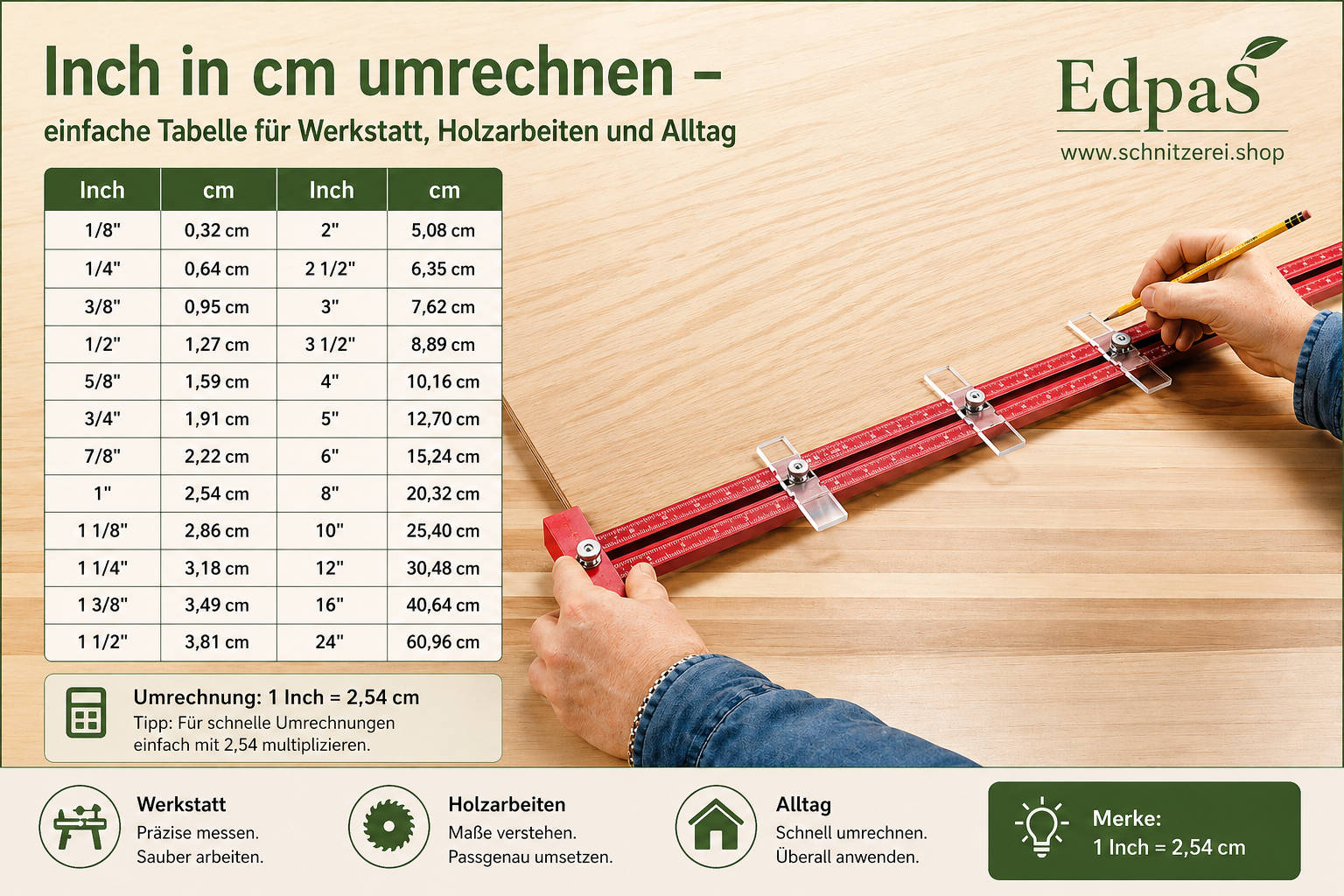
Converting inches to cm – a simple table for the workshop, woodworking, and everyday use
Anyone working with wood, tools, machine accessories, or international product specifications often encounters measurements in inches. Especially for tools, screws, drill bits, saw blades, wood thicknesses, or imported products from English-speaking countries, measurements are often not given in centimeters. To help you quickly find the correct value, we will explain here, simply and clearly, how to convert inches to cm and mm.
The most important formula is: 1 inch = 2.54 cm = 25.4 mm.
Table of Contents
- What is an inch?
- Is "inch" the same as "Zoll" (German for inch)?
- Converting inches to cm – the simple formula
- Converting cm to inches
- Table: inches to cm
- Table: cm to inches
- Converting inches to mm
- Inch fractions simply explained
- Why inch measurements are important in the workshop and for woodworking
- Inch measurements for wood and workpieces
- Practical tip for the workshop
- Frequently asked questions about inches and cm
- Conclusion: Quickly converting inches to cm
What is an inch?
An inch is an English unit of length. In German, the term "Zoll" is often used for it. This unit is mainly found in products from the USA, Great Britain, and other countries where technical measurements are often not given in metric units.
The symbol for inch is a double prime: ″. So if a product says 8″, it means 8 inches.
For conversion, the following applies:
- ✔ 1 inch = 2.54 cm
- ✔ 1 inch = 25.4 mm
- ✔ 1 inch = 1 Zoll (German for inch)
Is "inch" the same as "Zoll" (German for inch)?
Yes, in current usage, "inch" is the same as "Zoll". Both terms describe the same unit of measurement. In English-speaking countries, "inch" is usually used, while in German-speaking countries, "Zoll" is used.
You will most commonly find inch or "Zoll" measurements for tools, screws, threads, screens, bicycles, pipes, saw blades, drill bits, and international machine accessories.
Important: In the past, there were regionally different "Zoll" measurements. Today, however, in technical and international use, the fixed value 1 inch = 2.54 cm is used.
Converting inches to cm – the simple formula
Converting inches to centimeters is simple. You multiply the inch value by 2.54.
Formula:
Inches × 2.54 = Centimeters
Examples:
- ✔ 1 inch × 2.54 = 2.54 cm
- ✔ 5 inches × 2.54 = 12.70 cm
- ✔ 8 inches × 2.54 = 20.32 cm
- ✔ 10 inches × 2.54 = 25.40 cm
- ✔ 12 inches × 2.54 = 30.48 cm
So, if you have a measurement in inches, you just need to multiply it by 2.54. This will give you the value in centimeters.
Converting cm to inches
The reverse direction is also simple. If you want to convert centimeters to inches, you divide the centimeter value by 2.54.
Formula:
Centimeters ÷ 2.54 = Inches
Examples:
- ✔ 10 cm ÷ 2.54 = approx. 3.94 inches
- ✔ 20 cm ÷ 2.54 = approx. 7.87 inches
- ✔ 30 cm ÷ 2.54 = approx. 11.81 inches
- ✔ 50 cm ÷ 2.54 = approx. 19.69 inches
- ✔ 100 cm ÷ 2.54 = approx. 39.37 inches
This conversion is particularly helpful when you want to compare European measurements with international product specifications.

Table: inches to cm
In this table, you will find frequently searched inch values directly converted into centimeters. The values are rounded to two decimal places.
| Inch | Centimeters |
|---|---|
| 1 Inch | 2.54 cm |
| 2 Inches | 5.08 cm |
| 3 Inches | 7.62 cm |
| 4 Inches | 10.16 cm |
| 5 Inches | 12.70 cm |
| 6 Inches | 15.24 cm |
| 7 Inches | 17.78 cm |
| 8 Inches | 20.32 cm |
| 9 Inches | 22.86 cm |
| 10 Inches | 25.40 cm |
| 11 Inches | 27.94 cm |
| 12 Inches | 30.48 cm |
| 15 Inches | 38.10 cm |
| 20 Inches | 50.80 cm |
| 24 Inches | 60.96 cm |
| 30 Inches | 76.20 cm |
| 32 Inches | 81.28 cm |
| 40 Inches | 101.60 cm |
| 50 Inches | 127.00 cm |
| 60 Inches | 152.40 cm |
| 70 Inches | 177.80 cm |
| 80 Inches | 203.20 cm |
Table: cm to inches
If you want to convert centimeters to inches, this table will help you as a quick guide.
| Centimeters | Inch |
|---|---|
| 1 cm | 0.39 Inches |
| 2 cm | 0.79 Inches |
| 3 cm | 1.18 Inches |
| 4 cm | 1.57 Inches |
| 5 cm | 1.97 Inches |
| 10 cm | 3.94 Inches |
| 15 cm | 5.91 Inches |
| 20 cm | 7.87 Inches |
| 25 cm | 9.84 Inches |
| 30 cm | 11.81 Inches |
| 40 cm | 15.75 Inches |
| 50 cm | 19.69 Inches |
| 60 cm | 23.62 Inches |
| 80 cm | 31.50 Inches |
| 100 cm | 39.37 Inches |
Converting inches to mm
In the workshop, converting to millimeters is often even more important than converting to centimeters. Especially for drill bits, screws, routers, threads, or small woodworking projects, measurements are usually given in millimeters.
Formula:
Inches × 25.4 = Millimeters
Examples:
- ✔ 1 inch = 25.4 mm
- ✔ 2 inches = 50.8 mm
- ✔ 4 inches = 101.6 mm
- ✔ 8 inches = 203.2 mm
- ✔ 12 inches = 304.8 mm
For precise woodworking, carving, and technical applications, measurements in millimeters are particularly practical.
Inch fractions simply explained
Inches are often given not only as whole numbers but also as fractions. This is common for tools, wood thicknesses, screws, and American measurements.
Typical examples are:
- ✔ 1/8″ = one-eighth inch
- ✔ 1/4″ = one-quarter inch
- ✔ 1/2″ = one-half inch
- ✔ 3/4″ = three-quarters inch
- ✔ 1 1/2″ = one and a half inches
| Inch fraction | Centimeters | Millimeters |
|---|---|---|
| 1/8″ | 0.32 cm | 3.18 mm |
| 1/4″ | 0.64 cm | 6.35 mm |
| 3/8″ | 0.95 cm | 9.53 mm |
| 1/2″ | 1.27 cm | 12.70 mm |
| 5/8″ | 1.59 cm | 15.88 mm |
| 3/4″ | 1.91 cm | 19.05 mm |
| 7/8″ | 2.22 cm | 22.23 mm |
| 1″ | 2.54 cm | 25.40 mm |
| 1 1/2″ | 3.81 cm | 38.10 mm |
| 2″ | 5.08 cm | 50.80 mm |
Why inch measurements are important in the workshop and for woodworking
Inch measurements are encountered in many areas of craftsmanship. Especially with international tools, machine accessories, and wood products, it is important to understand the measurements correctly. Even small deviations can make a difference in wood joints, drillings, or precisely fitting workpieces.
Typical areas with inch or "Zoll" measurements:
- ✔ Scarving tools
- ✔ Drill bits and routers
- ✔ Screws and threads
- ✔ Saw blades
- ✔ Wood thicknesses and board dimensions
- ✔ Machine accessories
- ✔ Abrasives
- ✔ Rulers, scales, and measuring tools
- ✔ Screen and display sizes
Especially when carving, turning, crafting, or working with wood, it is worthwhile to accurately convert inch values to centimeters or millimeters.
Inch measurements for wood and workpieces
For wood products, precise measurements are particularly important. In Europe, wood pieces are usually specified in centimeters or millimeters, for example, 20 x 10 x 2 cm. In English-speaking countries, however, you often find measurements in inches.
A few simple examples:
- ✔ 4 inches correspond to 10.16 cm
- ✔ 6 inches correspond to 15.24 cm
- ✔ 8 inches correspond to 20.32 cm
- ✔ 10 inches correspond to 25.40 cm
- ✔ 12 inches correspond to 30.48 cm
When comparing a piece of wood, a cant, a board, or a tool from abroad, you should always convert the inch measurement. This way, you can immediately tell if the material is large enough for your project.
For carving, this is particularly helpful because the size of the workpiece must match the motif. A small blank, for example, is suitable for figures, pendants, or practice pieces. Larger cants or boards are better for spoons, relief work, bowls, decorative objects, or turning projects.
Practical tip for the workshop
If you frequently work with inch or "Zoll" measurements, a small conversion table in the workshop is worthwhile. This way, you can compare measurements directly without having to recalculate every time.
Particularly useful are:
- ✔ Measuring tape
- ✔ Ruler
- ✔ Calipers
- ✔ Squares
- ✔ Scribing tool
- ✔ Printout of an inch-cm table
For precise woodworking, we recommend working in millimeters for smaller measurements. Millimeters are more accurate and common in European craftsmanship.
Suitable tools for precise measuring and working
Anyone who regularly works with inch, "Zoll", centimeter, or millimeter measurements saves a lot of time with the right measuring tools. Especially in the workshop, for woodworking, carving, or DIY, it is helpful to check measurements directly, transfer them cleanly, and accurately recognize small differences.
Digital Calipers
Ideal for precisely measuring small dimensions in millimeters or inches – especially for drill bits, screws, router bits, and wood thicknesses.
View on AmazonTape Measure
Practical for larger workpieces, boards, machine accessories, and quick measurements in the workshop and everyday life.
View on AmazonCombination Square
Helpful for scribing, checking, and transferring right angles – especially for woodworking and cuts.
View on AmazonFrequently asked questions about inches and cm
How many cm is 1 inch?
1 inch is exactly 2.54 cm.
How many mm is 1 inch?
1 inch is exactly 25.4 mm.
How many cm is 10 inches?
10 inches is 25.40 cm.
How many cm is 12 inches?
12 inches is 30.48 cm.
How many cm is 8 inches?
8 inches is 20.32 cm.
What is the formula for converting inches to cm?
The formula is: Inches × 2.54 = Centimeters.
What is the formula for converting cm to inches?
The formula is: Centimeters ÷ 2.54 = Inches.
Are inches and "Zoll" (German for inch) the same?
Yes, in current usage, inch means the same as "Zoll". 1 inch equals 1 "Zoll" and is exactly 2.54 cm long.
Why are inches important in the workshop?
Many international tools, screws, drill bits, saw blades, and wood measurements are given in inches. Those who convert the values correctly can compare products better and work more precisely.
Conclusion: Quickly convert inches to cm
Inch and imperial measurements may seem unfamiliar at first, but they are very easy to convert. The most important value is:
1 inch = 2.54 cm = 25.4 mm
With this formula, you can quickly compare international measurements and better assess whether a tool, piece of wood, or accessory is suitable for your project.
Especially when working with wood, carving, turning, crafting, and DIY, precise measurements are important. A simple inch-cm table helps you find the right measurement faster and more reliably.