
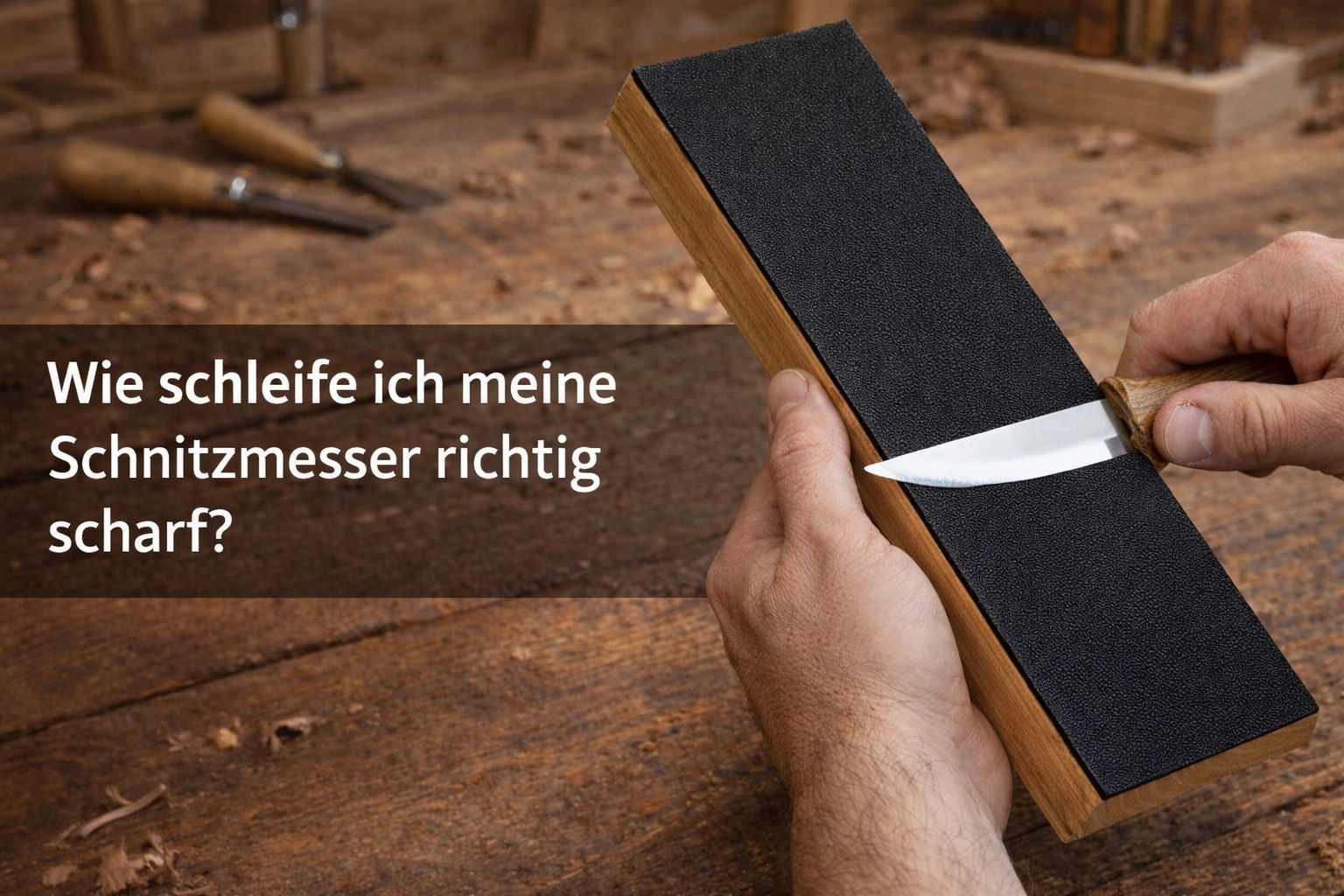
Sharpening Carving Knives Correctly – A Guide for Sharp Knives and Clean Carving Results
Sharp carving knives are the foundation for precise cuts, clean wood surfaces, and safe work. A dull knife requires more force, tears wood fibers, and is harder to control. With the right sharpening technique, suitable abrasives, and regular stropping, your carving tools will remain reliably sharp.
In this guide, you will learn step-by-step how to properly sharpen carving knives, what sharpening angle is appropriate, which sharpening stones you can use, and which mistakes to avoid when sharpening.
Table of Contents
- Why Sharp Carving Knives Are So Important
- The Most Important Tools for Sharpening Carving Knives
- Sharpening Stones for Coarse and Fine Grinding
- Leather Strops for Maximum Sharpness
- Step-by-Step: Sharpening Carving Knives Correctly
- 1. Check the Edge
- 2. Perform the Coarse Grind
- 3. Fine Grinding and Polishing
- 4. Test for Sharpness
- Sharpening Machine for Carving Knives – Sensible or Risky?
- Recommended Wet Grinders
- Avoid Common Sharpening Mistakes
- Care and Long-Term Sharpness Retention
- FAQ – Sharpening Carving Knives Correctly
- Conclusion: Sharp Carving Knives for Better Results
Why Sharp Carving Knives Are So Important
When carving wood, the sharpness of the edge determines control, cut quality, and safety. A cleanly sharpened blade glides more easily through the wood, allowing for fine details, smooth surfaces, and controlled cuts. This is especially true for soft carving wood like basswood, but also for harder woods.
A dull carving knife, on the other hand, is more strenuous and less safe. You have to apply more pressure, the knife slips more easily, and wood fibers can tear out.
The Benefits of Sharp Carving Knives
- ✔ Clean and smooth cut surfaces
- ✔ Less effort when carving
- ✔ Better control over the blade
- ✔ More precise details and finer contours
- ✔ Lower risk of slipping
- ✔ Longer lifespan of your carving tools
Anyone who carves regularly should consider sharpening and stropping an integral part of tool maintenance. Often, regular stropping on leather is sufficient before a proper coarse grind becomes necessary.
The Most Important Tools for Sharpening Carving Knives
You don't need many tools for sharp carving knives. The most important thing is the right combination of sharpening stone, leather strop, and polishing paste. Depending on the condition of the blade, a sharpening machine or a coarse stone may also be useful.
A sensible basic setup consists of:
- ✔ Sharpening stone for the coarse grind
- ✔ Fine sharpening stone for the fine grind
- ✔ Leather strop or stropping leather
- ✔ Polishing paste for leather stropping
- ✔ Water or suitable honing oil, depending on the stone type
- ✔ Cloth for cleaning and drying the blade
For beginners, it is particularly important not to use too many different sharpening tools, but to establish a simple routine. A consistent angle and regular stropping often yield better results than many different sharpening stones without a clear technique.
Sharpening Stones for Coarse and Fine Grinding
Sharpening stones form the basis for sharpening carving knives. They remove material from the edge and reshape the bevel. Which grit you need depends on how dull or damaged your knife is.
Typical grits for carving knives
- ✔ Coarse grit approx. 200–600: for chips, nicks, or very dull blades
- ✔ Medium grit approx. 800–1000: for regular coarse grinding
- ✔ Fine grit approx. 3000–8000: for fine grinding and polishing
Waterstones are very popular because they remove material quickly and allow for fine edges. Diamond stones are dimensionally stable, remain permanently flat, and are particularly well suited for harder tool steels. Oilstones usually work a little slower, but they are often very dimensionally stable and durable.
Which grit is suitable for beginners?
For beginners, a medium sharpening stone in combination with a leather strop is often sufficient. If the knife is not damaged, it does not need to be coarsely ground every time. For carving knives, regular stropping is often more important than frequent heavy grinding.
Leather Strops for Maximum Sharpness
The leather strop, also called stropping leather, is particularly important for sharpening carving knives. It provides the final step after the sharpening stone: the fine burr is removed, the edge is polished, and the blade achieves its fine working sharpness.
Why a leather strop is important
- ✔ Removes the fine burr from the edge
- ✔ Polishes the cutting edge
- ✔ Extends the life of the sharpness
- ✔ Improves the cutting feel when carving
- ✔ Reduces the need for frequent coarse grinding
The correct direction is important: the carving knife is always pulled away from the leather with the edge. If you push the edge into the leather, you can cut into the leather strop and damage the edge.
The angle for stropping should be slightly shallower than for grinding on the stone. This prevents the edge from becoming rounded.
Step-by-Step: Sharpening Carving Knives Correctly
A clear sharpening routine helps you achieve consistent results. A clean workbench, an appropriate sharpening angle, and smooth movements are important.
The following steps are suitable for many classic carving knives, chip carving knives, and detail knives.
1. Check the Edge
Before you sharpen, you should inspect the edge. Carefully hold the blade up to the light. Dull spots will reflect light and appear as bright lines or shiny dots on the cutting edge.
Pay attention to the following points:
- ✔ Are there any nicks or chips?
- ✔ Is the edge even?
- ✔ Are there shiny dull spots?
- ✔ Does the knife still cut cleanly into the wood?
- ✔ Is stropping on leather sufficient, or is a coarse grind necessary?
If the blade is only slightly dull, the leather strop is often enough. For noticeable dull spots or chips, you should start with a suitable sharpening stone.
2. Perform the Coarse Grind
During the coarse grind, the edge geometry is restored. Place the carving knife at the appropriate angle on the sharpening stone and move the blade smoothly and evenly over the surface.
For many carving knives, a sharpening angle of about 20 degrees is a good guideline. Very fine detail knives can be sharpened slightly shallower, at about 15–18 degrees. More robust blades can be a little steeper.
Important for Coarse Grinding
- ✔ Maintain the angle as consistently as possible
- ✔ Work with light to moderate pressure
- ✔ Perform even movements
- ✔ Carefully work both sides of the edge
- ✔ Do not grind in one spot for too long
As soon as a fine burr forms on the opposite side, the edge is sharpened all the way through. Then switch to the other side and repeat the process.
3. Fine Grinding and Polishing
After the coarse grind, the fine grind follows. This reduces coarse grinding marks and refines the edge. The finer the grit, the smoother the cutting edge will be.
After the fine sharpening stone, strop on the leather strop with polishing paste.
How to Strop the Carving Knife Correctly
- ✔ Pull the knife with the edge away from the leather
- ✔ Keep the angle slightly shallower than when sharpening
- ✔ Work without heavy pressure
- ✔ Perform several even strokes per side
- ✔ Check the edge regularly
Only through this step is the fine, smooth cutting edge created that works particularly comfortably when carving.
4. Test for Sharpness
After sharpening, you should check if your carving knife is truly sharp. There are simple tests that quickly show you if the edge is working cleanly.
You can recognize a sharp carving knife by:
- ✔ It cuts paper cleanly and without tearing
- ✔ It removes fine wood shavings in a controlled manner
- ✔ It glides through the wood without snagging
- ✔ It leaves a smooth cut surface
- ✔ It requires little force when cutting
The most important test is always the practical test in wood. If your knife cuts in a controlled manner, does not snag, and produces clean shavings, the sharpness is good for carving.
Sharpening Machine for Carving Knives – Sensible or Risky?
Sharpening machines can be helpful for sharpening carving knives, but must be used with caution. Dry high-speed grinders, in particular, are risky for fine carving knives because the edge can quickly overheat.
Risks with Dry Grinders
- ✔ High heat development at the edge
- ✔ Risk of hardness loss in the steel
- ✔ Excessive material removal
- ✔ Difficult to maintain a consistent angle
- ✔ Risk of damaging the fine bevel
Wet grinders with low speeds are significantly better suited. They work more controlled and cooler. This reduces the risk of the edge overheating or too much material being removed.
For high-quality carving knives: It is better to sharpen slowly, controlled, and cool than to grind quickly and aggressively.
Recommended Wet Grinders
If you regularly sharpen carving knives, chisels, or other woodworking tools, a wet grinder can be useful. It is particularly suitable for coarse grinding, for tools that are very dull, or for tools where a clean bevel needs to be re-established.
Possible Wet Grinders for the Workshop
- ✔ Scheppach Wet Sharpening System Tiger 7000S incl. Homekit
- ✔ WELDINGER Wet Grinding Machine NSM 200
- ✔ Tormek T-8 Original Wet Grinder with RB-180 Turning Disc
The Tormek T-8 is a high-quality solution for ambitious users and professional workshops. Models like Scheppach or WELDINGER can be interesting for beginners and hobbyists if a good price-performance ratio is sought.
With any machine, it is important to use suitable fixtures, maintain the angle cleanly, and work with little pressure. After machine grinding, the edge should always be finely stropped.
Avoid Common Sharpening Mistakes
Many sharpening problems arise not from poor tools, but from small application errors. Beginners, in particular, often change the angle, press too hard, or forget the leather strop.
Changing Sharpening Angle
An uneven angle leads to an irregular bevel. The edge is not cleanly formed and loses sharpness more quickly. Therefore, try to keep the angle as consistent as possible throughout the entire sharpening process.
Too Much Pressure
Heavy pressure does not make the knife sharp faster. On the contrary: it unnecessarily wears down the stone and the edge and can lead to an unclean bevel. It is better to work calmly, controlled, and with light pressure.
No Stropping on Leather
Anyone who stops after the sharpening stone often leaves a fine burr. The knife feels sharp for a moment but quickly loses cutting performance. The leather strop removes this burr and polishes the edge.
Wrong Grit
A grit that is too coarse is often unnecessary for slightly dull knives. It removes too much material. Only start with a coarse grit if the edge is damaged or has significant chips.
Overheating with a Sharpening Machine
With dry high-speed grinders, the edge can get very hot very quickly. If the steel overheats, it can lose hardness. Therefore, wet grinders or sharpening stones are usually the safer choice for carving knives.
Care and Long-Term Sharpness Retention
With proper care, you will need to perform a coarse grind on your carving knife much less frequently. Regular stropping on leather is particularly important. This keeps the edge fine and sharp for longer.
How to Keep Your Carving Knife Sharp for Longer
- ✔ After carving, remove resin, dust, and wood residues
- ✔ Store the blade clean and dry
- ✔ Regularly strop briefly on the leather strop
- ✔ Do not use the knife as a lever
- ✔ Do not cut on metal, stone, or hard surfaces
- ✔ For rusting steels, lightly oil the blade
- ✔ Store the knife safely so that the edge does not hit anything
Especially carving knives should not only be sharpened when they are completely dull. Those who regularly strop briefly will maintain sharpness longer and will need to grind away less material.
FAQ – Sharpening Carving Knives Correctly
What is the ideal sharpening angle for carving knives?
For many carving knives, a sharpening angle of about 20 degrees is a good guideline. Fine detail knives can be sharpened slightly shallower, at about 15–18 degrees. More robust carving knives can be a little steeper.
Is sandpaper a good alternative to a sharpening stone?
Sandpaper can work for minor corrections if used on a perfectly flat surface. However, it does not permanently replace a good sharpening stone, as it clogs and wears out faster.
Why should the angle on the leather strop be slightly shallower?
A slightly shallower angle prevents the edge from becoming rounded when stropping. This preserves the fine cutting edge and keeps the knife sharp for longer.
Are sharpening machines suitable for carving knives?
Yes, but wet grinders with low speeds are best. Dry high-speed grinders can overheat the edge and damage the steel. With high-quality carving knives, work should be particularly controlled.
How do I know that my carving knife is truly sharp?
A sharp carving knife cuts paper cleanly, removes fine wood shavings in a controlled manner, and glides through the wood without snagging. The cut surface appears smooth and clean.
How often do you need to sharpen a carving knife?
That depends on usage, wood type, and steel quality. Often, regular stropping on leather is sufficient. A proper coarse grind is only necessary when the knife no longer cuts cleanly despite stropping, or the edge is damaged.
What is better for carving knives: waterstone or diamond stone?
Both can work well. Waterstones offer a pleasant sharpening feel and fine results. Diamond stones remain flat and work reliably even with hard steels. For beginners, a simple, easily controllable solution is most important.
What is a burr when sharpening?
A burr is a very fine metal edge that forms on the cutting edge during sharpening. It indicates that the cutting edge has been worked all the way to the edge. Afterwards, the burr must be removed by finer sharpening and stropping on leather.
Conclusion: Sharp carving knives for better results
Sharpening carving knives correctly is not a complicated art, but it does require some practice and a clean routine. Crucial factors are a consistent sharpening angle, suitable abrasives, and regular stropping on leather.
A sharp knife cuts more easily, more controllably, and more cleanly. This makes carving more enjoyable and the results visibly better. Especially for beginners, it is worthwhile to pay attention to good tool care from the start.
Mnemonic: It's better to strop briefly and regularly than to sharpen intensely and rarely. This way, your carving knife stays sharp longer, and you remove less material from the blade.